


Southern Lake Huron Pilot Project
Learn more about the project and the Integrated Resource Planning process below.
About the project
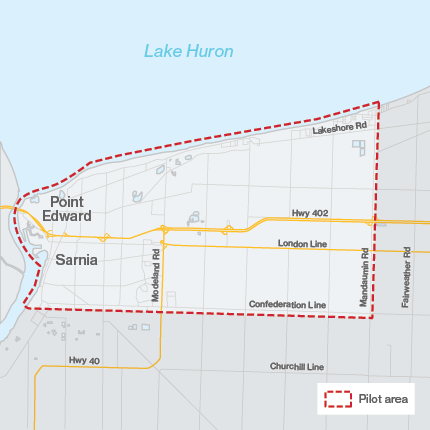
The Ontario Energy Board directed Enbridge Gas to implement pilot projects to understand and evaluate how Integrated Resource Planning Alternatives can be implemented to avoid, delay, or reduce the need for facility projects. As part of this direction, Enbridge Gas is delivering a pilot project for homes and businesses within the City of Sarnia and the Village of Point Edward in Lambton County.
Enbridge Gas has launched this pilot under the name Sarnia Saves. The Sarnia Saves pilot includes residential and commercial energy efficiency programs. The pilot project area is unique because much of the project area is already equipped with meter reading technology, allowing Enbridge Gas to collect usage data and gain a clearer picture of peak hour demand.
The pilot is designed to better understand the impacts of enhanced targeted energy efficiency and demand response programs on reducing peak-period natural gas demand. Participation in the pilot will provide Enbridge Gas with data and insight that can inform future IRP assessments on system needs.

Why we're doing it?
The pilot's purpose is to test and better understand the impacts that enhanced targeted energy efficiency (ETEE) and demand response have on reducing the natural gas system’s peak period demand and how to best design and deploy ETEE and demand response programs.

How will this impact me?
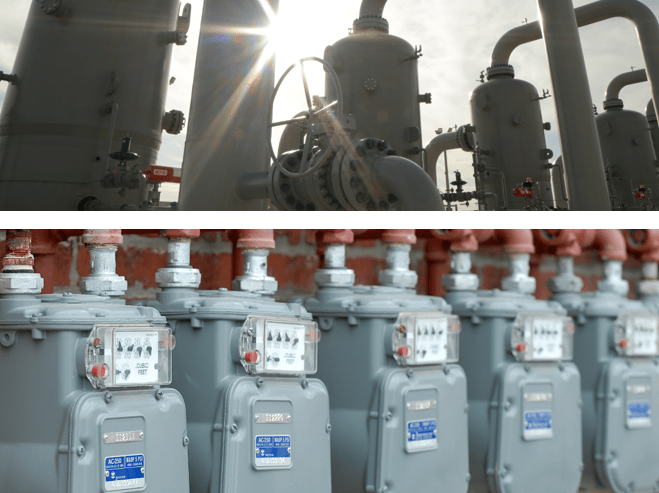
The pilot project has been designed to have no impact for the targeted communities other than the ability for customers to participate in the programs. Automated meter reading (AMR) technology is already installed on the majority of customer meters, which allows Enbridge Gas to collect hourly usage data. This will help us better understand how enhanced energy efficiency and demand response programs impact peak natural gas demand.
Collecting hourly data from meters equipped with AMR technology will not disrupt your service, nor will there be any additional charges on your bill.

What are the benefits?
The learnings from this pilot project are expected to support Enbridge's Ontario-wide system planning.
The pilot, similar to existing DSM programs, will give participating customers access to improve energy-efficiency and home comfort.
Regulatory updates
The Ontario Energy Board has approved the pilot project, and the decision on the pilot and its associated costs is now available.
What is IRP?
Integrated Resource Planning (IRP) is a natural gas planning strategy and process1. Through the IRP process, we forecast what energy demand will look like, determine whether a traditional pipe project or an alternative will meet the energy need, and then lay out a roadmap for how we’ll manage it. As part of this process, we gather input and feedback from communities on what matters most.
Non-pipeline alternatives can include:
- Demand side alternative:
- Lowering or shifting energy use through energy efficiency programs such as ETEE programs or demand response (DR) programs.
- Supply side alternative:
- Delivering more energy without adding new pipeline using compressed natural gas (CNG) or liquified natural gas (LNG).
- Adding supply through upstream deliveries.
Alternatives can be implemented individually or in combination to meet the system need cost effectively and within the required timeframe.
1 IRP Framework was published by the OEB on July 22, 2021.
How Enbridge Gas is Supporting a Net Zero Future
Energy warms our homes, powers our vehicles and helps produce and move the goods we use every day. As our climate changes, energy systems are evolving, working together to meet our future energy needs sustainably.
For us, innovation comes naturally. We’re collaborating to advance new green technologies to fuel transportation, heat buildings and power industry. We’re introducing new renewable fuels and finding practical ways to use less energy.
The most cost-effective and resilient path to net-zero*Net zero means reducing GHG emissions to as close to zero as possible, then balancing any remaining emissions with an equivalent amount of carbon removal through environmental actions and innovative technology.
https://www.canada.ca/en/services/environment/weather/climatechange/climate-plan/net-zero-emissions-2050.html emissions requires electric and gas systems to work together. This includes increased electrification of building heat, personal and light-duty vehicles; greening the gas supply with renewable natural gas and hydrogen; and powering industry with hydrogen and blended natural gas, combined with carbon capture.
This collaborative approach will:
- Reliably meet our energy needs, even on the coldest days.
- Meet the energy needs of industries like concrete and steel production, and heavy transportation that can’t be practically electrified.
- Minimize costs for energy consumers.
- Provide consumers flexibility to make choices on their path to net zero.
Energy sources
Transition to renewables.
A mix of renewable power, renewable natural gas and hydrogen for clean and reliable energy.Transportation
Switch to lower-emission sources.
Electrification of light-duty vehicles and compressed and renewable natural gas and hydrogen for hard-to-electrify heavy transport.Building heating and cooling
Adopt high-efficiency technologies.
Energy conservation, heat pumps, hybrid heating, geothermal, district energy and green fuels for clean and reliable heat.Industrial processes
Advance innovative technologies.
Energy conservation, hydrogen and carbon capture for processes that can't easily be electrified.